
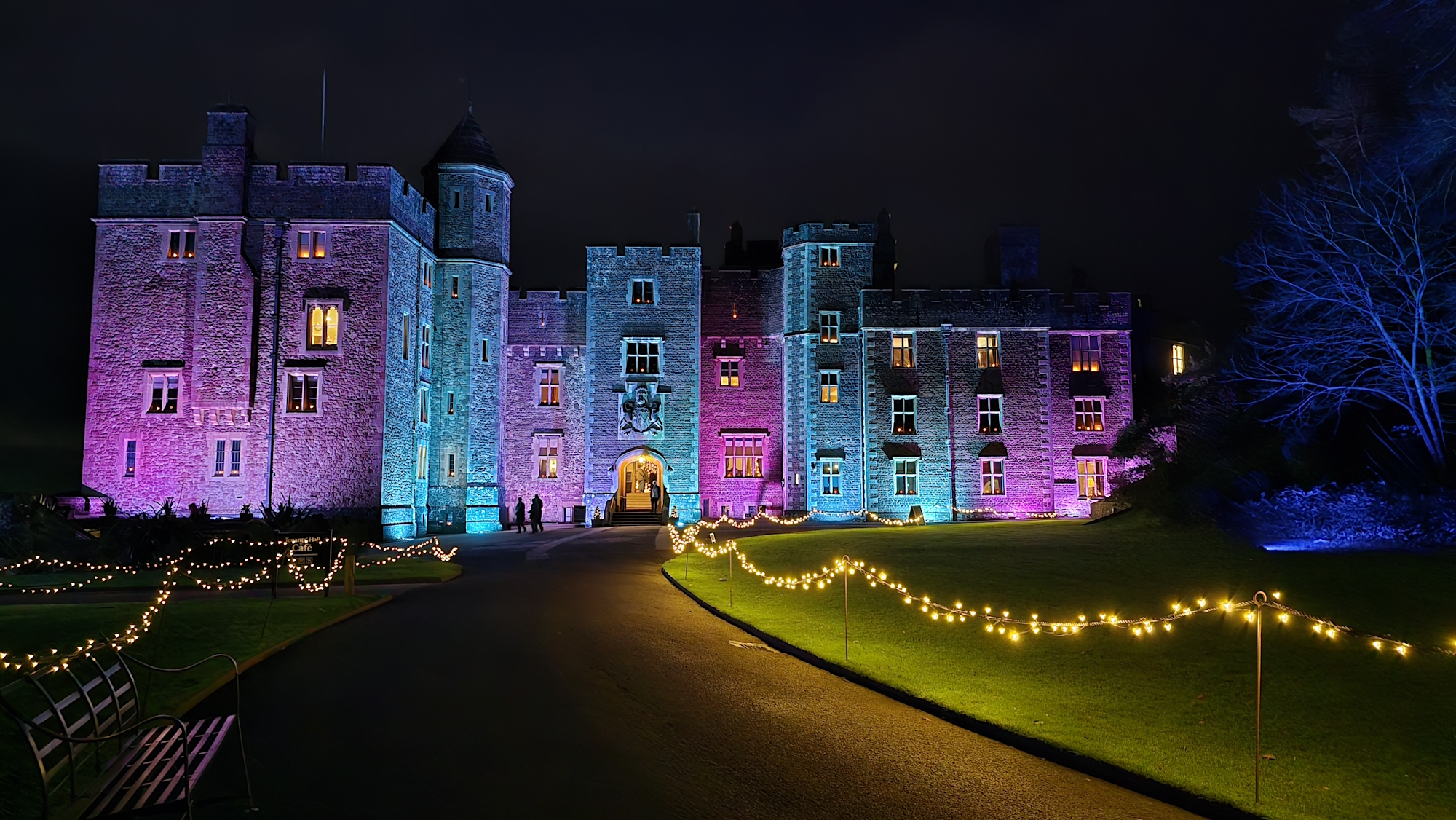
If you love castles, history, and afternoon tea, Dunster Castle will tick all the boxes. Situated in one of the best-preserved medieval villages in England, Dunster village in Somerset is on the edge of Exmoor National Park.
The castle couldn’t be better placed to reveal 1,000 years of history. From humble beginnings to becoming a flagship property in the National Trust portfolio, Dunster Castle has kept many of its secrets well hidden until now. Visiting a medieval castle built on the site of an earlier fortified settlement and travelling through the centuries is an experience not to be missed.
The imposing red stone castle, with its 13th-century gatehouse and sub-tropical Mediterranean-inspired terraced gardens leading down to a historic working watermill, makes for a memorable day out. Few places on the National Trust’s roster combine medieval fortifications, Victorian renovations, and exotic gardens quite so effortlessly – although the steep walk up to the castle may remind visitors that medieval builders rarely planned for comfort.
Early History (11th–12th Centuries)
The Saxons settled in the Dunster area around 700 AD, arriving from northern Germany and the Netherlands. They established this part of Somerset as the headquarters of an Anglo-Saxon commander named Dun or Dunna, from whom the village is believed to take its name.
According to BBC Bitesize, Roman soldiers left Britain in AD 410, creating an opportunity for new groups to settle across the country. The Anglo-Saxon age in Britain lasted from around AD 410 until the Battle of Hastings in 1066, when the Norman Conquest reshaped England.
The site where Dunster Castle stands today originally housed a West Saxon fortress, overseen by the last Saxon nobleman of the area, Aelfric (or Aluric). Its location was no accident. The hill offered an ideal defensive position while also dominating the surrounding landscape. Those same advantages that appealed to early builders are the reason the castle still stands today for visitors to explore.
What happened next is probably the most famous battle in English history; the legacy changed the course of events for Dunster Castle. In 1066, Norman invaders defeated the English forces at the Battle of Hastings. As a result, the Norman commander William de Mohun (Moion) le Viel (“the elder”) was granted fifty-five West Country manors, including Dunster.
After becoming the Sheriff of Somerset in 1086, de Mohun built a motte-and-bailey timber castle on the site of the former Anglo-Saxon burgh. The Normans scarped the summit of the Tor to create the motte, also known as the Upper Ward, and reshaped the lower ground beneath it to form the bailey, or Lower Ward.
During this period, the castle served as the caput (administrative centre) of the Norman establishment in the region and as a defensive stronghold protecting Somerset from raiders approaching along the coastal road or by sea. In the early 12th century, William’s son was also named William – constructed the stone fortifications surrounding the upper part of the motte.
Dunster Castle is also a great place to learn more about the Battle of Hastings, a battle that, interestingly, did not actually take place in Hastings. Instead, it was fought near the town of Battle in East Sussex, about six miles away. The event is one of the most famous in English history, yet several commonly repeated “facts” about the battle are widely believed but not entirely true. Here are a few of them:
- King Harold almost certainly didn’t die as a result of an arrow through his eye. The Bayeux Tapestry depicts this scene in detail, but historians believe that this is poetic licence.
- The English army was not easily beaten. They held a strong defensive position. According to many historians, the battle was eventually turned when Norman forces used feigned retreats to lure English fighters out of the successful shield wall formation.
- The Battle of 1066 was not Harold’s only outing that month – by the time Harold faced William, his army had already fought the Battle of Stamford Bridge a week earlier and then marched the length of England (250 miles) to fight some more.
An exhausting prelude to one of the most famous clashes in British history.
The Anarchy and Seizure of Dunster Castle (1138)
During the civil war known as ‘The Anarchy’, England was divided between supporters of King Stephen of England and those backing his rivals, Empress Matilda. At this time, Dunster Castle was one of the most important Norman strongholds in the southwest.The council was held by William de Mohun, a powerful supporter of Matilda. Because of its strategic position controlling the Bristol Channel coast and routes into Exmoor, Stephens forces targeted it early in the conflict. In 1138, royalist troops built a temporary siege castle in the village of Dunster. This was a common medieval tactic that allowed attackers to blockade a fortress and control the surrounding area.
After a prolonged struggle, Stephen’s supporters managed to take Dunster Castle. However, the victory did not last. As the war shifted in Matilda’s favour in parts of the West Country, William de Mohun eventually regained control of the castle. In recognition of his loyalty, Matilda is believed to have granted him the title Earl of Somerset, although the title was short-lived and not widely recognised by Stephen’s government.
During the 13th century, the castle was fortified by William’s great-grandson, Reginald de Mohun. He replaced many earlier timber defences with stone buildings in the Lower Ward, including:
- Two defensive towers
- A fortified gatehouse controlling entry to the castle
- A granary for storing supplies during sieges
The upper ward remained the administrative and residential heart of the fortress. It contained the Chapel of St Stephen, a great hall, kitchens, pantry and bakehouse, along with accommodation for knights and retainers. Together, these structures make Dunster one of the most formidable castles in Somerset and the surrounding areas.
The Era of the Luttrell Family (1376-1976)
After the death of John de Mohun (The last male heir of the de Mohun family at Dunster) in 1376, the long association of the de Mohun family and Dunster Castle came to an end. John left no surviving heirs, and his widow, Joan Burghersh, decided to sell the castle and its estates.
In the same year, Joan agreed to sell Dunster Castle to Elizabeth Luttrell for 5,000 marks (a sum that equates to many millions in today’s money). The agreement allowed Joan to retain possession of the castle for the rest of her life, with ownership transferring to the Luttrell family upon her death. As it happened, Elizabeth died before Joan, so the inheritance passed to Elizabeth’s son, Sir Hugh Luttrell. When Joan finally died in 1404, Sir Hugh formally took possession of Dunster Castle, beginning the Luttrell family’s remarkable 600-year association with the castle, which lasted until 1976.
What’s interesting here is that women generally had no real legal rights unless they were widows. While they may have mourned the loss of their husbands, widowhood gave them a degree of independence under the medieval dower system, allowing them to hold and manage land. The sale was likely arranged to ensure that Dunster Castle did not fall into the hands of John of Gaunt (brother of Edward the Black Prince), which would have turned Dunster into a Lancastrian royal fortress. Instead, the private agreement ensured the castle was removed from any inheritance disputes and passed securely into the hands of Elizabeth Luttrell and the Luttrell family.
Dunster Castle History – Remodelling and Expansion
Initially, the Luttrell family began to repair and expand the castle, gradually transforming it from a military stronghold into a country home for the whole family. Major works carried out between 1419 and 1424 included the construction of the Great Gatehouse, a defensive barbican, and a new entrance built using imported Bristol red stone, while the roofs were covered with Cornish stone tiles.
Key improvements during this period included:
- Construction of the Great Gatehouse, which still forms the main entrance to the castle today
- A barbican creating an additional defensive barrier before the gatehouse
- A new stone entrance approach built using imported Bristol red sandstone
- Replacement of earlier roofing with durable Cornish stone tiles
Continued transformation of the castle from a fortified Norman stronghold into a noble residence
The Period of Civil Wars (15th–17th Century) at Dunster Castle
The Wars of the Roses
During the Wars of the Roses, the Luttrell family supported the House of Lancaster. Sir James Luttrell died fighting for the Lancastrian cause at the Second Battle of St Albans. After the Lancastrian defeat later that year at the Battle of Towton, the Luttrell family temporarily lost control of Dunster Castle to the Yorkist supporter William Herbert. However, the family regained possession when the Lancastrian claimant, Henry VII, came to the throne in 1485.
The Elizabethan and Jacobean Transformation
After inheriting the castle in 1571, George Luttrell began transforming the medieval fortress into a more comfortable country residence. In 1617, he employed the master mason and architect William Arnold, who was responsible for several important West Country houses. Under Arnold’s direction, parts of the castle were remodelled in the Jacobean style, introducing more domestic architecture with square towers, larger windows and decorative plaster ceilings, reflecting the shift from fortress to country house.
The English Civil War and Dunster Castle
During the English Civil War between supporters of Charles I and Parliament, the owner of Dunster Castle, Thomas Luttrell, initially supported the Parliamentarian cause. Expecting a Royalist attack, the castle was strengthened in preparation for a siege.
In 1642, the castle’s garrison, led by Thomas’s wife Jane Luttrell, successfully resisted an attack by Royalist forces commanded by William Seymour. However, in 1643, the castle was eventually forced to surrender, and the Luttrell family were compelled to submit to Royalist control. In 1645, Parliamentarian forces under Robert Blake captured Dunster Castle. A Parliamentary garrison was installed, and the castle returned to Parliamentarian hands.
After the Civil War, Parliament ordered many Royalist strongholds to be slighted (partially demolished) so they could not be used again for military purposes. George Luttrell successfully persuaded the authorities to limit the destruction. As a result, much of the outer medieval defences were dismantled, while the residential parts of the castle survived. Today, the Great Gatehouse and the bases of two towers in the Lower Ward remain among the principal surviving elements of the medieval fortress.
Modernisation of Dunster Castle
After marrying the wealthy Dorset heiress Mary Tregonwell in 1680, Francis Luttrell began a programme of modernisation in parts of Dunster Castle. Among the most attractive additions from this period is the carved dark-wood staircase, decorated with hunting scenes and acanthus leaves, attributed to the renowned craftsman Edward Pearce.
Later, Margaret Luttrell, the daughter of the then heir to the estate, married Henry Fownes Luttrell, who adopted the Luttrell surname. The couple moved to the castle in 1747and carried out several improvements. Henry raised the ground level in the Lower Ward, added decorative towers beside the Great Gatehouse, and redesigned parts of the interior using fashionable Rococo-style wallpapers.
From Country House to Somerset Tourist Attraction
In 1816, John Fownes Luttrell opened the castle to visitors while living mainly in London. Later, in 1867, George Fownes Luttrell inherited the estate and began the most extensive modernisation project of the Victorian era. For this work, he employed the well-known architect, Anthony Salvin.
Salvin’s renovations introduced many significant additions, including a large underground reservoir capable of holding about 40,000 imperial gallons of water, which helped provide a reliable water supply for both the castle and the village.
He also constructed a modern conservatory, installed a gas plant for lighting and heating, introduced Victorian-style windows, and created a large gathering hall. The interior was also remodelled, creating new spaces such as the Outer Hall, a billiard room, a drawing room, a library, and a gallery on the first floor.
Anthony Salvin also worked on the restoration of several major British castles, including Windsor Castle (Berkshire), Norwich Castle (Norfolk), Rockingham Castle (Northamptonshire), Newark Castle (Nottinghamshire), Warkworth Castle (Northumberland), Muncaster Castle (Cumbria), and Warwick Castle (Warwickshire).
Final Years of the Luttrell Family in Dunster Castle
In 1910, Alexander Luttrell inherited Dunster Castle but chose to live at the family’s Court House in East Quantoxhead. His son Geoffrey Luttrell returned to occupy the castle in 1920, renovating several rooms in a more contemporary style and even creating a polo ground beside the castle.
During World War II, particularly between 1943 and 1944, the castle was used to accommodate and assist injured soldiers, American personnel, and naval officers. After Alexander’s death, Geoffrey inherited the estate but found it increasingly difficult to meet the heavy inheritance taxes placed on large properties at the time. As a result, he sold the castle and around 8,600 acres of surrounding land to the Ashdale Property Company, though he continued to live there as a tenant.
In 1954, Geoffrey was able to purchase the castle back when it was later acquired by the Crown Estate, allowing the family to regain ownership. Geoffrey’s son, Walter Luttrell, was the final member of the Luttrell family to own the castle. Choosing to live elsewhere, and following the death of his mother, he decided to pass the property on. In 1976, he transferred ownership of the castle and much of its contents to the National Trust.
Modern Dunster Castle (1976–Present)
Today, Dunster Castle is one of the best-known historic attractions in England. The property is owned and managed by the National Trust and is recognised as both a Scheduled Ancient Monument and a Grade I listed building.
In 2008, the National Trust installed solar panels on a discreet section of the castle roof behind the battlements to help provide environmentally friendly power. In April 2016, the authorities also opened the 19th-century underground reservoir, originally built during the Victorian renovations, to the public.
Must see Highlights at Dunster Castle
Dunster Castle shows a blend of architectural styles, reflecting centuries of building and rebuilding from the Norman period onward. Although the castle originated as a medieval fortress, much of what visitors see today dates from later alterations by the Luttrell family, particularly in the 17th and 18th centuries, when the castle was gradually transformed into a comfortable country house.
Only a few parts of the medieval castle survive today. The most prominent is the Great Gatehouse, built by Sir Hugh Luttrell around 1420, along with the remains of defensive towers and walls in the Lower Ward. Visitors can also see elements of the earlier inner gateway, which dates back to the 13th-century de Mohun castle.
Inside the castle, several historic objects and interiors are on display. These include the Blüthner baby grand piano owned by Vivian Ellis, as well as artworks such as the allegorical portrait of Sir John Luttrell. One of the most unusual features is a rare series of painted leather wall hangings that illustrate the story of Antony and Cleopatra. These decorative leather panels are considered one of the finest surviving examples of this type in Britain. Another highlight is the beautifully carved wooden staircase, decorated with hunting scenes and acanthus leaves, attributed to the master craftsman Edward Pearce.
During a visit, look out for rooms such as the Justice Room, once used as an office by George Fownes Luttrell, and the elegant Victorian Drawing Room, which reflects the lifestyle of the Luttrell family during the castle’s later years as a country residence.
Highlights at Dunster Castle
If you’re visiting Dunster Castle and don’t have all day, here are a few features you shouldn’t miss:
- The Great Gatehouse – built around 1420 by Sir Hugh Luttrell, this impressive entrance once controlled access to the fortress and still forms the main gateway today
- The Lower Ward Towers – Remains of the medieval defensive walls that hint at the castle’s past as a powerful Norman stronghold
- The De Mohun Inner Gateway – parts of the 13th-century entrance from the original de Mohun castle can still be seen inside the complex.
- The Carved Wooden Staircase – a remarkable dark-wood staircase decorated with hunting scenes and acanthus leaves, attributed to the master craftsman Edward Pearce.
- The Painted Leather Wall Hangings – rare decorative panels illustrating the story of Antony and Cleopatra, among the finest surviving examples of painted leather wall coverings in Britain.
- The Victorian Drawing Room – a glimpse into the later life of the castle as a grand country residence under the Luttrell family.
- The Justice Room – once used as an office by George Fownes Luttrell during the castle’s 19th-century renovations.
Finally, the Blüthner piano once owned by Vivian Ellis is a reminder that Dunster Castle continued to evolve well into the modern era. Recitals are still occasionally held here, so it’s worth checking the website for upcoming events.
Recent Comments